Raising Veggies Part 1: Beautiful Brassica
A Veggie Worthy of an Empire
The Roman Empire was in a fifty-year state of chaos before Diocletian came to the throne in 284 AD. Previous to his ascension, power rested in one emperor, but no one could agree on who that emperor should be, resulting in a series of political assassinations. Diocletian thought he could end the madness by inventing a new political system with multiple emperors, and for a while it worked. Satisfied with the peace he brought Rome and eager for such peace in his personal life, Diocletian abdicated and retired to his estate in Salona (modern-day Croatia).
His political solution was temporary, though, and in 308 the empire was on the verge of another civil war. Two of Rome’s leading politicians pleaded with him to return to power and do what he did before: pacify the realm. Diocletian was not interested, responding, “If you could see at Salona the cabbages raised by our hands, you surely would never judge that a temptation.”
He could have offered a multitude of alternative explanations, so we have to think Diocletian really did adore his cabbages. But what specifically about the cabbages did he love? Was it the act of gardening cabbages? The food made from cabbage? The use of cabbage as medicine? Or simply the relief of only having to garden and not run an empire?
Before addressing that question we need to admit that in the original Latin he didn’t refer to cabbages specifically; he used the Latin word olera, which refers to vegetables and herbs in general. It was Edward Gibbon in his masterpiece The History of the Decline and Fall of the Roman Empire who chose to translate the word as “cabbage”, with other translators following.
If Diocletian wanted to single out cabbage specifically he would have used the Latin word brassica, but even if he did, there would still be some ambiguity. Today we think of cabbage as the plant that produces a large and tight ball of crunchy leaves. A plant that, when harvested, most resembles a soccer ball. For a Roman foodie, though, brassica referred more to a plant that resembles today's kale. Cato the Elder (234-149 BC) describes three different brassica varieties: one having smooth, large leaves with a large stalk, another having crumpled leaves, and a wild variety which was said to possess greater “strength”, by which he meant it was particularly useful as a medicine.
Brassica oleracea
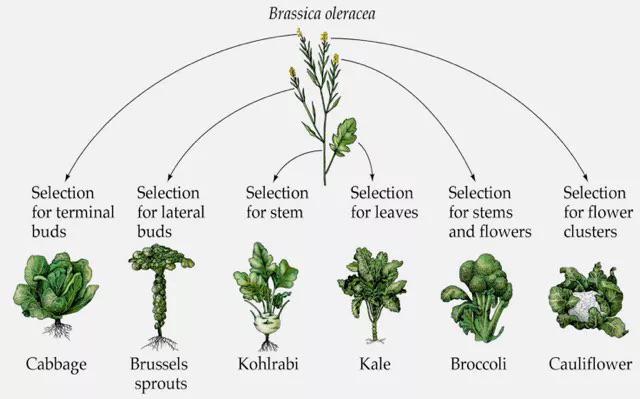
As the centuries went by plant breeders created a pantheon of different Brassica types. Some, like cabbage, are valued for their spherical overlaying of leaves. The ones we call broccoli and cauliflower are loved for the taste of its immature flowers, whereas kale is valued for its flavorful leaves. Then there's walking kale, that grows a tall and large stem—perfect for making into a walking stick. Kohlrabi makes a delicious and versatile bulb, and Brussels sprouts produce a stem with mini little cabbage heads attached to it. When we read ancient Latin texts use the term "Brassica" it's not clear exactly what that Brassica may have looked like, because the same term could be used to describes plants taking on all different shapes and sizes. Carl Linnaeus (1707 - 1778) helped clear matters when he devised the modern taxonomy of biological life in his 1753 Species Plantarum. This is where he categorized all organisms according to their Domain, Kingdom, Phylum, ... and Species. You were perhaps taught to memorize this taxonomy through the mnemonic phrase, "Dear King Philippe Came Over For Good Soup (Domain, Kingdom, Phylum, Class, Order, Family, Genus, Species)." Today, the plant we call cabbage is official a species called Brassica oleracea, where "Brassica" is the genus. Cauliflower, Brussels sprout, kohlrabi, kale, and walking kale are also in the species Brassica oleracea, they are just different "varieties" or "cultivars" within that species.
The many varieties/cultivars of the Brassica oleracea species.
Brassica rapa and canola oil
There are some other plants in the Brassica genus that can breed with Brassica oleracea. Turnips belong to the species Brassica rapa; so does Chinese / Napa cabbage, the preferred plant for making kimchi. At some point a Brassica oleracea and a Brassica rapa plant interbred and created the [unfortunately named] "rape" plant. Its oils can be extracted and used for machine lubricant, but its high livels of erucic acid make it unhealthy for human consumption. Then a group of Canadian using traditional plant breeding techniques was able to produce a rapeseed with low levels of erucic acid, and found it provided an excellent cooking oil. Now all it needed was a better name than "rapeseed" oil. They choose the name "canola", which is derived from "Canada-oil-low-acid."
Brassica nigra and Dijon mustard
The Brassica nigra provides foods through its leaves when eaten raw in salads or cooked like spinach, its immature flower stems can be eaten like broccoli, and the pungency of its dark seeds are used to make curries. At one point a Brassica nigra bred with a Brassica rapa to create the new species Brassica juncea, whose seeds are the traditional ingredient in Dijon mustard.
The relationships between these six varieties of Brassica plants are shown in the famous Triangle of U, below.
The Triangle of U for the Brassica genus

Mustards and the Triangle of U
We started talking about cabbages and now we seem to have moved onto "mustard". What's going on here? Technically, cabbage is a mustard, as are all the plants in the Brassica genus. But not all mustard are in the brassica genus. In the scientific classification of plants, above the genus is the family. The Brassica genus belongs to the Brassicaceae family, all of which are commonly referred to as the mustards. So yes, all the Brassica oleracea plants are mustards. Most mustard condiments are made with plants from different species within the Brassicaceae family, though. The conventional yellow mustard Americans put on their hamburgers and hotdogs are from the Sinapis genus, and the Dijon mustard for fancier meals is from the Brassica juncea species, but a good mustard condiment can be made from Brassica oleracae plants also.
Introducing the Brassicaceae family

Since cabbage, kale, and broccoli are all the same species, Brassica oleracea, they can breed with each other. As the Triangle of U shows, they can also breed with some of the other plants in the Brassicaceae, including its wild versions, like the wild cabbage that can still be found around the Meditarranean and the Dover Cliffs of England. This means you can buy broccoli seed and let it flower and produce its own seed, but if it is pollinated by other Brassicaceae plants its seed might not produce broccoli—it might barely even resemble broccoli. And because there are many wild Brassicaceae plants around the world, growing your own plants for seed can be difficult.
Korean farmers in the 12th centuy had to purchase their cabbage seed from China, as wild versions of cabbage kept pollinating their crops, dilluting the original cabbage seed DNA with their own. For similar reasons, cabbage growers in ancient Egypt had to buy their seed from the iland of Rhodes. Producers of specific Brassica oleracea variety seeds then must make sure to grow their varieties in an area devoid of other Brassicaceae plants.
The bounty of Brassica
References
Janick, J., & Paris, H. (2022). History of controlled environment horticulture: ancient origins. HortScience, 57(2), 236–238. https://doi.org/10.21273/HORTSCI16169-21
Maggioni, L., von Bothmer, R., Poulsen, G., & Lipman, E. (2018). Domestication, diversity and use of Brassica oleracea L., based on ancient Greek and Latin texts. Genetic Resources and Crop Evolution, 65(1), 137–159. https://doi.org/10.1007/s10722-017-0517-7
Pseudo-Aurelius Victor. (1911). Epitome de Caesaribus (F. Pichlmayr, Ed.). Teubner.
Muckenhoupt, M. (2018). Cabbage: A global history. Reaktion Books.