Raising Veggies Part ?: Starting vegetables
Many vegetables are started in a greenhouse and then later transplanted into the field, as opposed to just planting seeds in the ground of the field they will be grown. For cool season crops this is often necessary because you want the plants growing in the field during times of the year when it is too cold for the seeds to germinate. For warm season crops this is sometimes done to give them a good heads start before they have to compete with weeds in the field. A greenhouse is no modern invention. Even during the reign of Emperor Tiberius (42 BC - 37 AD) a type of greenhouse called a specularia was being used to grow his beloved cucumbers all year round.
“Anyone who wishes to have the fruits of cucumber [cucumis] ripen earlier than usual should, when midwinter is past, produce well-manured soil enclosed in baskets and give it a moderate amount of water; then, when the seeds have come up, he should place the baskets in the open air on warm and sunny days near a building, so that they may be protected from any blasts of wind; but if it is cold and stormy, he should bring them back under cover and continue to do so until the spring equinox is over. He should then sink the whole baskets into the ground. He will then have early fruits. It is also possible, if it be worth the trouble, for wheels to be put under larger vessels, so that they may be brought out and then taken indoors again with less labour. In any case the vessels ought to be covered with slabs of transparent stones [specularibus] so that even in cold weather, when the days are clear, they can safely be brought out into the sun. By this method Tiberius Caesar was supplied with cucumis during almost the whole year.” De Re Rustica X1. III. 52–53 (Forster and Heffner, 1955).
“Belonging to the class of cartilaginous plants and growing on the surface of the ground is the cucumber [cucumis] for which the emperor Tiberius had a remarkable partiality: in fact, there was never a day which he was not supplied with it, as his kitchen gardeners had cucumber [cucumis]bedsmountedon wheels which they moved out into the sun and then on wintry days withdrew under the cover of frames glazed with transparent stone.” Historia Naturalis XIX. XXIII. 64 (Rackham, 1950).
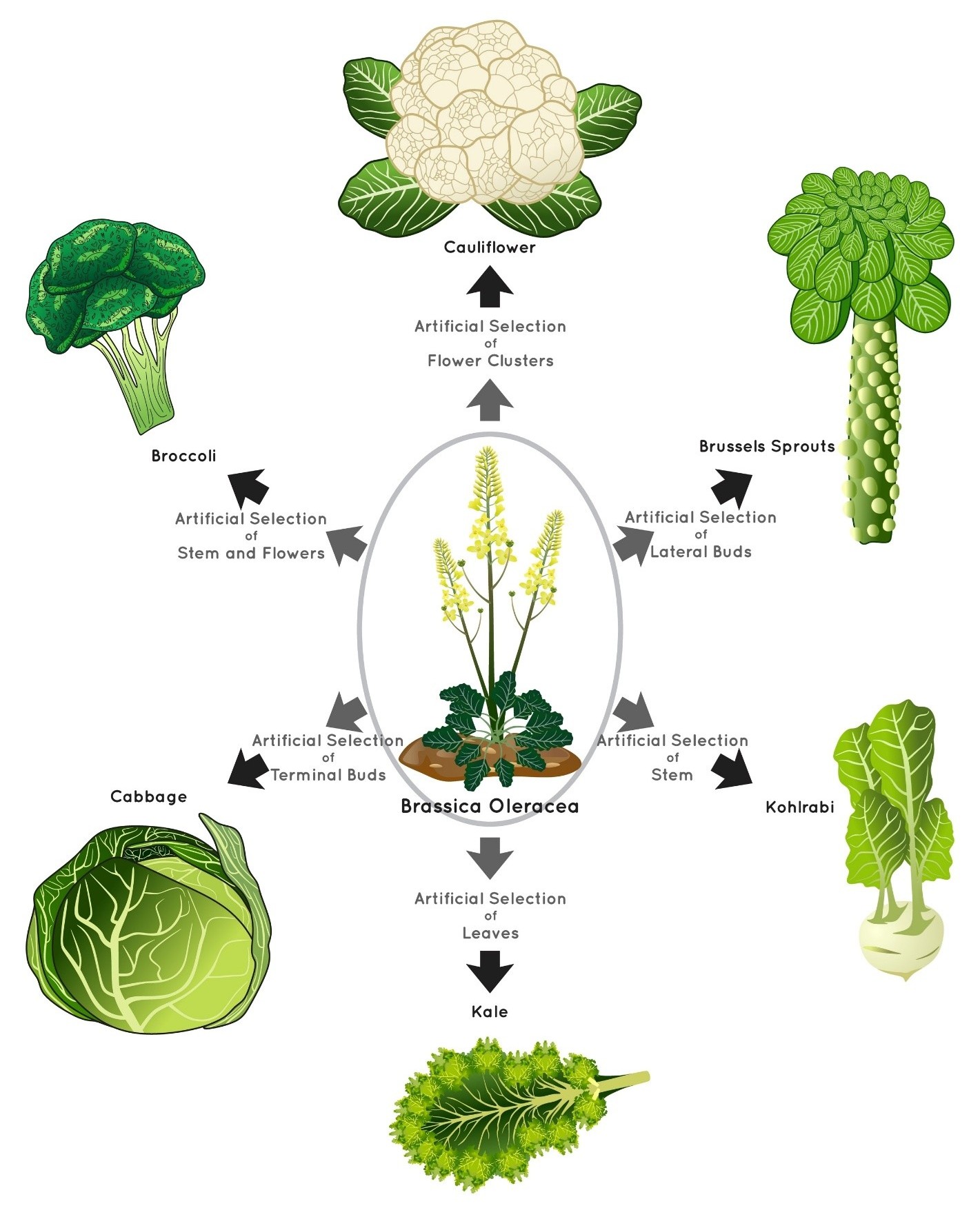
We too love the brassica, and appreciate the many shapes and forms it can take, both due to their beauty and the variety of flavors they provide. In the South it is a sin to eat barbeque without coleslaw, which of course is made with cabbage. Broccoli and cauliflower are common in Asian stir fries, Brussell sprouts are an ideal roasting vegetable, and kale can really spruce up an otherwise bland salad. While we no longer consider them “medicine” in the same way we do antibiotics, the brassica are one of many vegetables considered part of a healthy diet. (Of course, no one takes them as a hangover cure anymore!) Moreover, we raise them in much the same way, starting them by seed in a greenhouse and later transplanting them into a field, and like Diocletian, a gardener can obtain considerable joy from watching the brassica plants begin looking all alike as seedlings and then taking their unique and varied shapes and flavors.
References
Forster, E.S. and E.H. Heffner (eds.). 1955. Lucius Junius Moderatus Columella. On agriculture andtrees.Vol.3,p.162–163. Harvard University Press, Cambridge, MA.
Janick, J., & Paris, H. (2022). History of controlled environment horticulture: ancient origins. HortScience, 57(2), 236–238. https://doi.org/10.21273/HORTSCI16169-21
Oklahoma State University Extension: Cole Crop Production (Broccoli, Cabbage, and Cauliflower), Fact Sheet HLA-6026.
Rackham, H. 1950. Pliny natural history, p. 462–463. Vol. V. Harvard University Press, Cambridge, MA.